REACH4MHE
About the Project
The Researching Ethics and Assessment of Unintended Consequences in Healthcare for MHE (REACH4MHE) project is a core initiative of the Mental Health, Earlier (MHE) Center that leverages the pre-mortem method to identify and reduce unintended consequences that could arise during the implementation of mental health interventions. The MHE Center has the potential to improve outcomes for children and families through the implementation of the DECIDE Tool and Family Check-Up (FCU) Online. However, unintended consequences, like increased stigma for minoritized groups or isolation due to inadequate treatment, could undermine these benefits. REACH4MHE helps ensure that these interventions are fair, ethical, and effective for all children and families by leading pre-mortem workshops, which anticipate and mitigate unintended consequences before they occur.
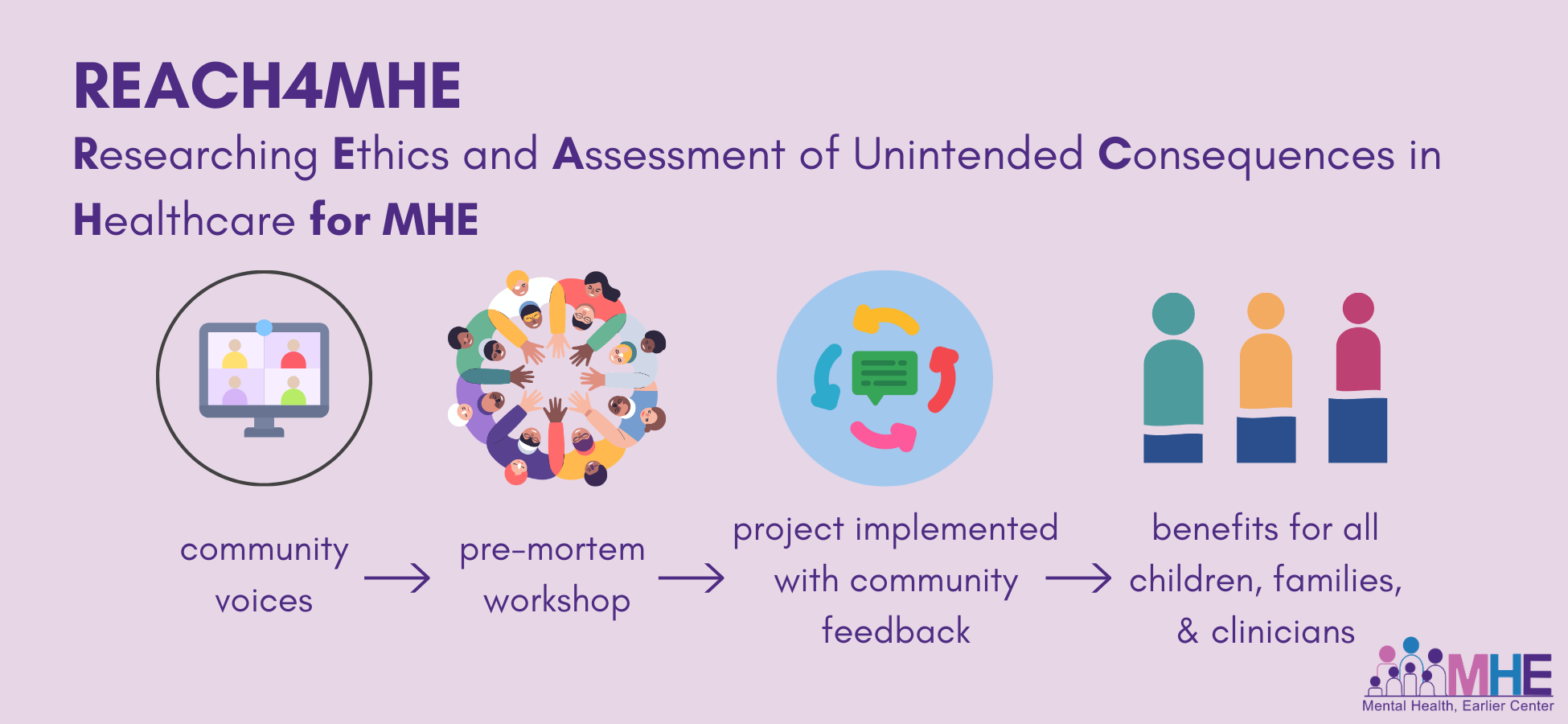 A pre-mortem is a structured brainstorming exercise that uses prospective hindsight. Participants (e.g., researchers, clinicians, and caregivers) imagine that a project has failed and ask, “What went wrong and why?” This forward-looking approach helps identify risks that might otherwise go unnoticed until it’s too late. During these sessions, participants envision a scenario where MHE Center interventions have failed to fairly and equally benefit all children and families, healthcare providers, and clinics. They generate ideas about potential risks from unintended consequences and solutions to avoid or minimize risks and maximize benefits. The REACH4MHE team then compiles these insights into a roadmap of priority concerns and solutions (i.e., implementation strategies). We also develop monitoring approaches to track whether unintended consequences emerge during the research, so strategies can be adapted to address concerns as needed.
Instead of waiting until the end of a project to evaluate success or failures of ethical implementation of the intervention, REACH4MHE acts proactively and leverages the power of prospective hindsight. Our findings about unintended consequences and implementation strategies can guide each stage of the MHE projects. By integrating implementation science and ethical frameworks to extend previous pre-mortem methods, we create a rigorous, replicable methodology that can inform future research.
REACH4MHE Team
Rinad Beidas(she/her/hers)
Project Co-Lead
Seema Shah(she/her/hers)
Project Co-Lead
Callie Walsh-Bailey(she/her/hers)
Co-Investigator
John Walkup(he/him/his)
Co-Investigator
Gabby Olson(she/her/hers)
Senior Research Study Coordinator
Ava Jurden, MA(she/her/hers)
Research Program Manager